Why a 0.5% fee costs you about 13% of your wealth over 30 years
Half a percent sounds like nothing. Over 30 years it takes more than an eighth of your final balance, because the fee hits your whole portfolio every year, not just the gains.
In short
- At a 5% return, $10,000 grows to $43,219 in 30 years. With a 0.5% fee it grows to $37,453.
- The gap of $5,766 is 13.3% of the fee-free balance.
- Cheap funds do better on average: funds in the cheapest fifth succeeded three times as often as those in the most expensive fifth.
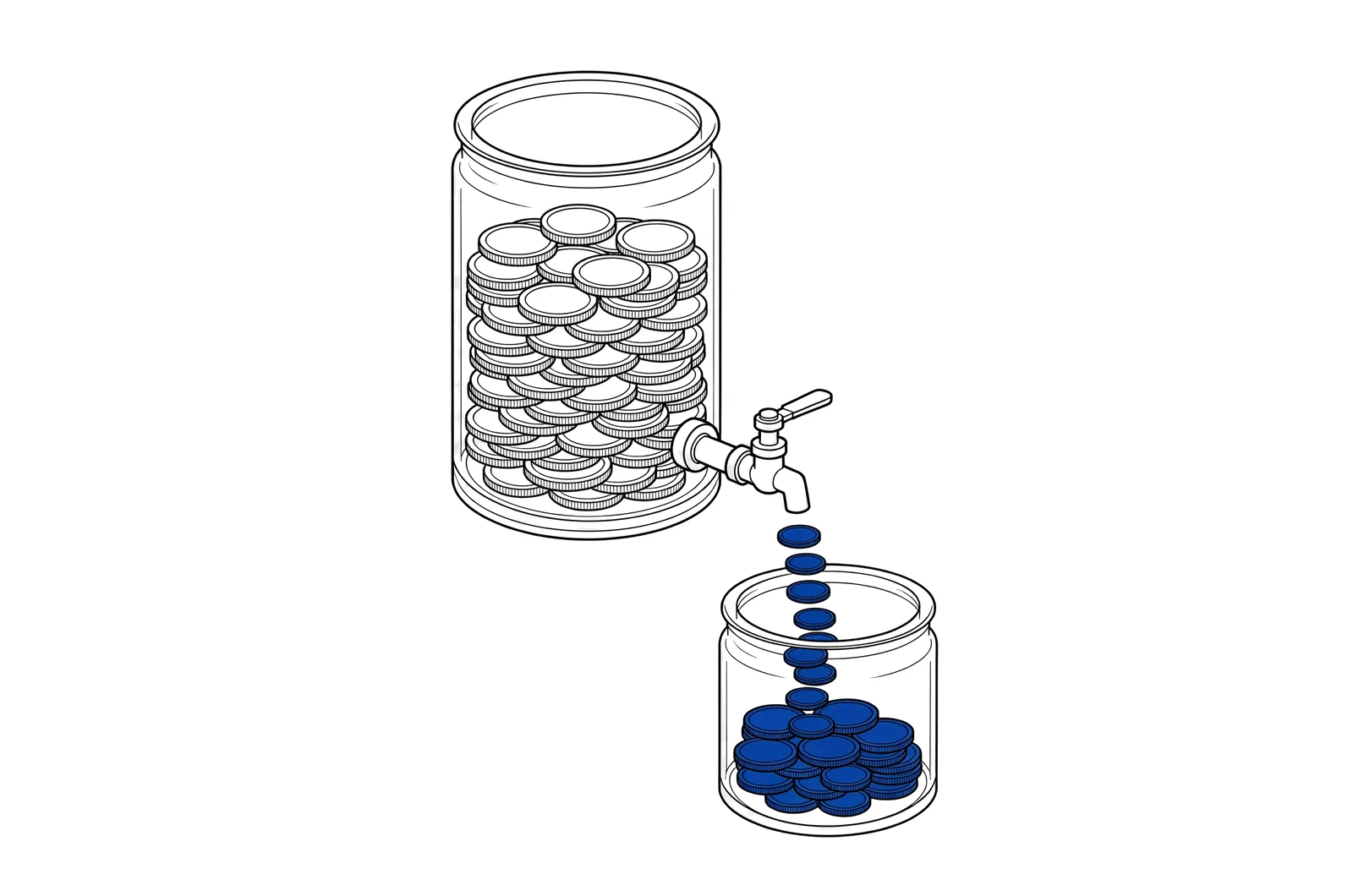
Fund fees are charged as a percentage of your balance, every single year. That lowers more than one year’s return: it shrinks the base on which every following year compounds.1 The U.S. Securities and Exchange Commission shows the same effect with its own numbers: $100,000 earning 4% a year grows to about $208,000 in 20 years with a 0.25% fee, but only to about $179,000 with a 1% fee.2
What half a percent costs
- No fees
- With a 0.5% fee
Simplified: annual compounding, fee deducted from the return, no taxes.
Show as table
| Year | No fees | With a 0.5% fee |
|---|---|---|
| 0 | 10,000 | 10,000 |
| 5 | 12,763 | 12,462 |
| 10 | 16,289 | 15,530 |
| 15 | 20,789 | 19,353 |
| 20 | 26,533 | 24,117 |
| 25 | 33,864 | 30,054 |
| 30 | 43,219 | 37,453 |
After 10 years the gap is only $759. After 30 years it is $5,766, or 13.3% of the fee-free balance.1 The gap grows faster than the balance itself, because every dollar taken out earns nothing in all the years that follow.
Fee calculator
| After | A | B | Difference |
|---|---|---|---|
| 5 yrs | CHF 12,462 | CHF 12,702 | CHF 240 |
| 10 yrs | CHF 15,530 | CHF 16,134 | CHF 605 |
| 20 yrs | CHF 24,117 | CHF 26,032 | CHF 1,915 |
| 30 yrs | CHF 37,453 | CHF 42,001 | CHF 4,548 |
Simplified: the same return every year, costs deducted directly from the return, savings at the end of each month. Before taxes and inflation.
Your entries stay in this browser only.Open as its own page
Why cheap funds usually do better
Fees are certain; returns are not. Morningstar looked at which funds beat their category over time. Among U.S. stock funds in the cheapest fifth, 62% succeeded, against 20% in the most expensive fifth.4
Economist William Sharpe calculates that, under plausible assumptions, a saver who chooses low-cost investments can enjoy a standard of living in retirement more than 20% higher than someone in high-cost products.3
Where to find the costs
The key number is the expense ratio, usually shown on the fact sheet as TER or “ongoing charges.” It covers the fund’s running costs. What your bank or platform charges for custody and trading comes on top. For a fair comparison, add up:
- each fund’s expense ratio,
- your platform’s custody fee,
- any sales or redemption charges, spread over how long you plan to hold.
Put it into practice
0 of 4 done
What we don’t know
- The calculation assumes a constant return. Real markets swing; the exact gap at the end depends on the path.
- Some expensive funds beat cheap ones over some periods. Which ones will do so is not knowable in advance.
- Taxes and transaction duties are left out; they depend on where you live and what you buy.
Sources
- 1Own calculation: $10,000, 5% return before costs, annual compounding, 30 years
- 2How Fees and Expenses Affect Your Investment Portfolio, Investor Bulletin
- 3The Arithmetic of Investment Expenses
- 4How Fund Fees Are the Best Predictor of Returns
- Written by
- Roman Henggeler, Publisher
- Published
Two articles a week
Health and money, checked and read in five minutes.