How much meat is healthy? What guidelines and studies say
Meat is not poison, but the amount matters, and the type matters even more. For sausage, ham and bacon, the evidence is much clearer than for steak.
In short
- The WHO’s cancer agency classifies processed meat such as sausage and ham as carcinogenic: each 50 g portion eaten daily raises the risk of colorectal cancer by about 18%.
- For unprocessed red meat, the link is less firmly established.
- The World Cancer Research Fund advises no more than about three portions of red meat a week and very little, if any, processed meat.
- Switzerland recommends meat at most 2 to 3 times a week, yet in the national survey Swiss adults ate more than twice that maximum.
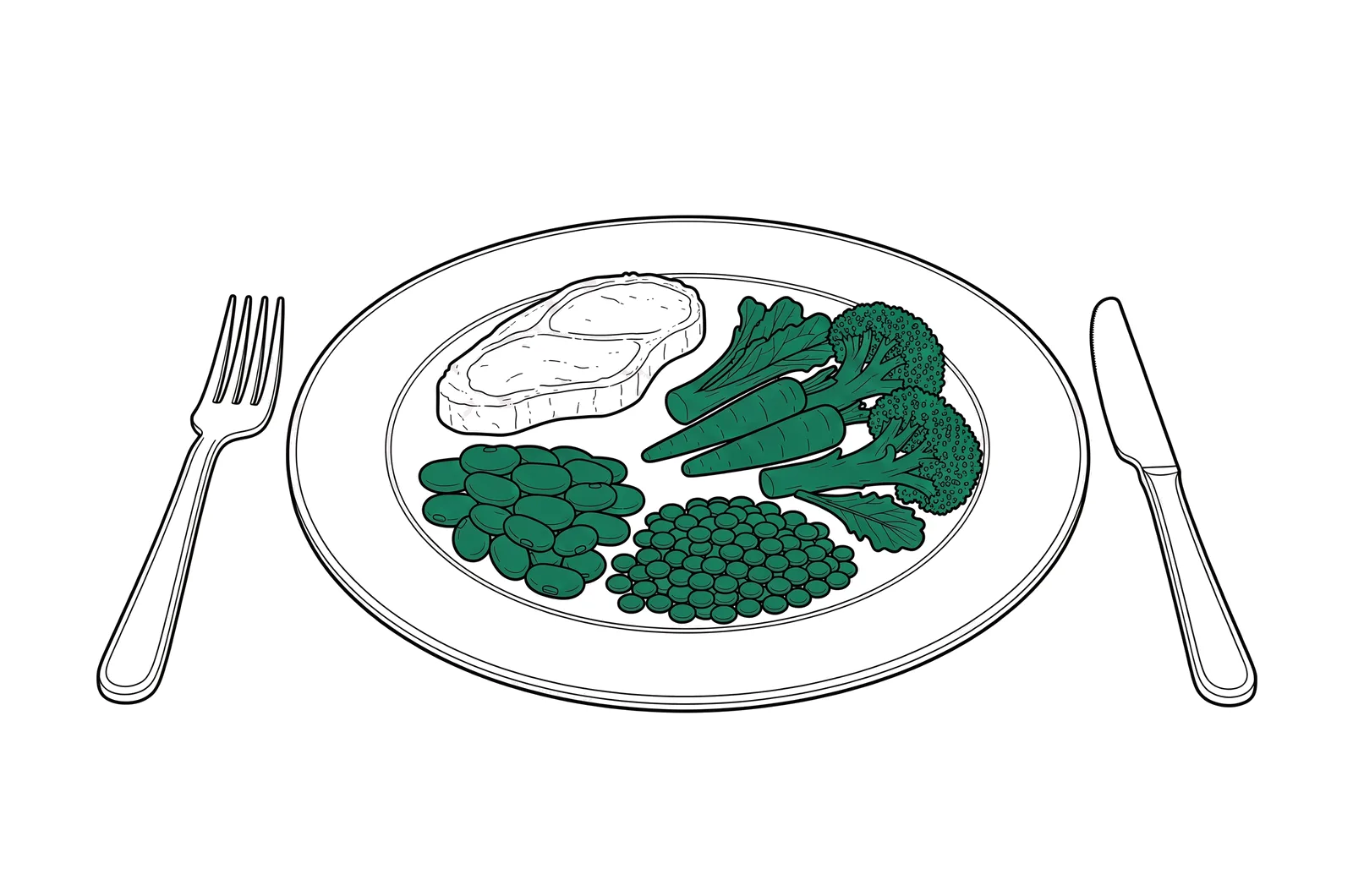
When people ask whether meat is healthy, they usually mean two different things: processed meat such as sausage, ham, bacon and salami, and unprocessed red meat such as beef, pork or lamb. The evidence differs a lot between the two.
Processed meat: the clearest evidence
The International Agency for Research on Cancer (IARC), part of the World Health Organization, classifies processed meat as carcinogenic, in the same group as tobacco. This means meat that has been salted, cured, fermented or smoked. Each 50 g portion eaten daily raises the risk of colorectal cancer by about 18%.1
The group only says how firmly the link is established, not how large the risk is. Sausage is not as dangerous as smoking. Worldwide, about 34,000 cancer deaths a year are estimated to be due to diets high in processed meat.1
The World Cancer Research Fund reaches the same conclusion: there is convincing evidence that processed meat causes colorectal cancer. It therefore advises eating very little, if any.2 A meta-analysis also found that 50 g of processed meat a day was linked to a 42% higher risk of coronary heart disease and a 19% higher risk of diabetes.3
Red meat: probable, but less firmly established
For unprocessed red meat, the picture is less clear. IARC classifies it as “probably carcinogenic”. If the link is causal, colorectal cancer risk would rise by about 17% for each 100 g portion eaten daily.1 The World Cancer Research Fund advises no more than about three portions of red meat a week, 350 to 500 g cooked weight in total.2
For unprocessed red meat, the 2010 meta-analysis found no statistically significant link with coronary heart disease or diabetes, but it was based on only four to five studies.3 A much larger 2024 analysis of 31 cohort studies with almost 2 million adults found a 10% higher diabetes risk for each 100 g of unprocessed red meat a day, and a 15% higher risk for each 50 g of processed meat.6
An example: Switzerland
The Swiss dietary recommendations published in 2024 advise eating meat at most 2 to 3 times a week, including poultry and processed meat, with a portion of 100 to 120 g. At most, that is 360 g a week. They also recommend legumes at least once a week, about 60 g uncooked.4
Actual eating looks different. In the national menuCH survey of 2014 and 2015, about 2,000 adults aged 18 to 75 ate 111 g of meat a day on average, 44 g of it processed. That is about three times the mid-range recommendation of about 35 g a day, measured ready to eat.5 It is also more than twice the maximum of 360 g a week, or about 51 g a day.
| Meat per day | of which processed | |
|---|---|---|
| Men | 140 g | 55 g |
| Women | 81 g | 32 g |
| Average | 111 g | 44 g |
| Recommended (mid-range, ready to eat) | about 35 g |
What this means day to day
Keeping meat within these limits and cutting back above all on sausage, ham and bacon follows what the evidence supports most clearly. Beans, lentils and chickpeas provide protein without meat.
Meat calculator
7 portions, 4 more than the 2 to 3 a week at most, poultry and processed meat included.
Red meat: 220 g, within the limit of about 350 to 500 g cooked a week.
Processed meat: 150 g a week, 21 g a day on average. Advice: very little, if any.
For context: according to the WHO’s cancer agency, colorectal cancer risk rises by about 18% for every 50 g of processed meat eaten daily.
Weights are approximate. The World Cancer Research Fund counts cooked meat, which weighs less than raw meat.
Your entries stay in this browser only.Open as its own page
Put it into practice
0 of 5 done
What we don’t know
- Most data come from observational studies. People who eat a lot of meat often live differently in other ways too.
- The WHO’s cancer agency could not determine whether any amount of processed meat is entirely risk-free.
- The Swiss consumption figures come from the menuCH survey of 2014 and 2015. Eating habits may have changed since.
Sources
- 1Q&A on the carcinogenicity of the consumption of red meat and processed meat, IARC Monographs Volume 114
- 2Limit red and processed meat, Cancer Prevention Recommendations
- 3Red and processed meat consumption and risk of incident coronary heart disease, stroke, and diabetes mellitus: a systematic review and meta-analysis
- 4Swiss dietary recommendations for adults, short version (German)
- 5Meat consumption in Switzerland 2014/15, nutrition fact sheet (German)
- 6Meat consumption and incident type 2 diabetes: an individual-participant federated meta-analysis of 1·97 million adults with 100 000 incident cases from 31 cohorts in 20 countries
- Written by
- Roman, Publisher
- Published
Two articles a week
Health and money, checked and read in five minutes.